Loneliness in all shapes and forms | Mental Health Awareness Week 2022

There was no way we could let May go by without talking about Mental Health Awareness Week which kicks off on May 9th. An annual event that gives us, and the whole of the UK for that matter, the opportunity to focus on achieving good mental health. While we firmly believe focusing on our own mental health is something that should be done daily (not just for a week) for the majority of folk, this awareness campaign is dedicated to highlighting specific issues we are facing as a nation when it comes to our collective mental health.
The Mental Health Foundation started the event 21 years ago, year on year setting a different theme to shine the spotlight on. This year, it’s loneliness.

We’ve been thinking about this a lot since the theme was announced, why loneliness? It’s no surprise that since the pandemic loneliness is affecting more and more people across the country, so why look at it now? Well, the simple answer is like most of the outcomes that were being tracked throughout the height of Covid, loneliness had an immediate and knock-on effect. Being isolated at home throughout each lockdown of course was the immediate effect. Being separated from friends and family, the pandemic took away our connections, our tribes, our support network – in person at least. Even though we were safe in our homes, some of us were alone during that time.
And even if we weren’t physically alone, the sharp removal of everyday routines thrust us a lot more into an overwhelming feeling of loneliness.
Name Here
Loneliness wasn’t experienced in the same way across our communities either. People with long-term physical conditions, people on lower incomes and people with existing mental health problems were more likely to experience loneliness compared to the general UK population.
Even getting used to a more digital way of life came tinged with loneliness for those who weren’t confident in being digitally connected. For some the whole idea of a life communicating online was just alien. While for others, work and life took place in chat rooms and on Zoom calls. Our worlds were very much physically closed. Turn the clock forward to now and we’re facing a pandemic of long-term loneliness, driven by social anxiety and uncertainty. During the lockdowns, The Mental Health Foundation found that loneliness was almost 3 times that of pre-pandemic levels.

The Mental Health Foundation CEO, Mark Rowland, explains the theme for Mental Health Awareness Week and has shared his own experience of loneliness: “I was in my early thirties the first time I knew I was lonely. My marriage had disintegrated, I was living in a new flat and I was travelling 120 miles a week to see my young son. The feeling of loneliness was crushing as I struggled to keep in contact with friends and family at exactly the time when I needed them the most.”
Loneliness is something that we all feel at times, it is after all a totally normal feeling, but when it is chronic or long-term it can have serious effects on our mental health. And there are any number of circumstances that can make us feel lonely. From the most mundane daily tasks to situations of heightened emotions, such as all those milestones we are presumed to tick off throughout our lives. – relationships, finding ourselves through them, marriage, parenthood, education, work life, family life.
The best news is that we all have a part to play in reducing loneliness. Our connection to other people and the communities within which we live is a fundamental way we can protect our mental health and, in short, we need to find better ways of tackling this knock-on epidemic of loneliness. Reducing loneliness is a major step towards a mentally healthy society.
We listened to Episode 129 of The Diary of a CEO podcast recently, with special guest Dr Ranjan Chatterjee. Host Steven Bartlett and Chatterjee discuss the idea of making a negative incident the hero moment. Being the architect of your own health and happiness, and loneliness is very much something we can apply that idea to.
Loneliness can be a very dangerous thing, as is the fact that post-pandemic society is making us lonely. We no longer have our ‘tribes’ around us, like we would have centuries ago. That lonely feeling can be as bad for us as smoking 15 cigarettes a day, potentially leading to increased chances of heart disease, earlier age of mortality, higher blood pressure… it can make us physically unwell as well as mentally.
In our ancient tribes, loneliness was a signal, a sign of vulnerability to attack, it activates our stress response making us feel anxious, racing heart rate, sweating. These physical bodily responses aren’t designed to be sustained for long periods of time. So, we now we ask, what can we do to tackle this pandemic?
One of the things we can do is to reach out to help others feel less lonely. Clubs, groups, networks, communities have all declined following the impact of the pandemic. From peer support groups or platforms through schemes at work to community groups such as the two we run – The Westerly Club and The F Word – reducing isolation through community is a great way to ease and reduce that feeling of isolation – whether you’re ready to meet up in person or stay online for now.
There is so much you can do during the week. Take the chance to get in touch with that friend or neighbour you haven’t spoken with in a while. Make use The Mental Health Foundation’s Loneliness School Pack to help teachers and pupils explore the theme in schools and download the Wear it Green fundraising Pack to show your support for the week.
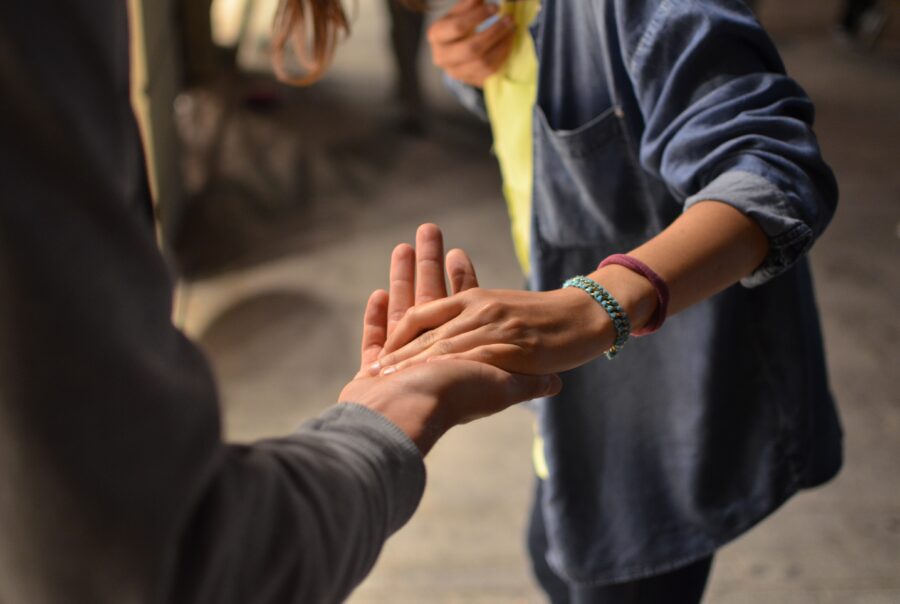
Most of all, we want to hear your stories of loneliness. We will be sharing some of our own too, over on our social platforms, to help reduce the stigma around loneliness and challenge the stereotypes about who experiences loneliness and how it affects us.
Get involved, invite conversations about loneliness at work and at home, and look into volunteering in your own time too. Whether you’re feeling lonely or are looking to help others in the throes of loneliness.
Our MD, Alexis, shares her thoughts about loneliness: “In a digital world, where we have access to anyone 24-hours a day, people can feel less connected than ever before. The habits of being on a phone when sitting with family, or during meals with a partner or in a meeting mean we aren’t really connecting with the people in the room, the people right in front of us, in a way that is meaningful.
“Relationships takes time, personal investment, communication and allowing vulnerability. During the last two years we were told to socially distance which is not right – we needed to physically distance. People became a threat. But also, we became a threat to others. Single people, lone parents, solopreneurs, older adults could all suffer from a sense of overwhelm due to the reduction of in-person social networks.
“The five ways of wellbeing includes ‘connect’ – building relationships and connecting. This can feel like taking a huge risk if people feel a threat or you’re an introvert or been feeling lonely. Loneliness can impact on confidence, self-esteem and identity. Small steps are so important – people can feel lonely in a room full of people so it’s about purposeful connection and finding something where there’s a shared interest, something fun, supportive and a feeling of being welcome. Reaching out is so important, being honest about how you’re feeling and if it doesn’t work first time try not to take this as a rejection, keep trying. Also, if you know someone you think may be lonely, offering time, checking in, are all helpful and can make someone’s week.
“It’s also worth mentioning here that cutting down on phone usage could help. Charge your phone in a different room and put devices out of reach during dinner are easy ways to shift your focus back into the here and now, to be more present with those people around you. Think less about documenting on social media and more about creating memories in the room.”